But, when it comes to choosing an AI platform…which do we recommend?
Our team—like most people—has heard a lot about ChatGPT, and has experimented with that tool for various tasks.
But Gemini—the AI platform formerly known as Bard—is making some major waves in the world of AI, and we wanted to dive in and do some comparative analysis.
quickly, let’s talk about the boring technical stuff…
Technically speaking, ChatGPT and Gemini are built on two different language platforms. ChatGPT uses GPT4 or GPT3.5, based on whether you are a free or premium user. Gemini uses—you guessed it—Gemini, or Gemini Ultra if you’re a premium user.
The difference in these language models is in the user experience. ChatGPT is more conversational—think of using ChatGPT like chatting with a subject-matter expert to solve a problem. Gemini, on the other hand, will process information and automate tasks in a more streamlined and time-efficient manner.
In terms of where each of these platforms retrieves its information, ChatGPT is still drawing solely from its training data, where Gemini is hooked in with Google itself. This means that ChatGPT may be relying on outdated information, where Gemini, by default, uses the latest and greatest.
From a technical standpoint—despite Gemini’s most recent and impressive updates, and the fact that it draws directly from Google’s knowledge base—experts are giving ChatGPT the leg-up on the who’s-better-than-who AI contest…
But it ain’t over ‘til it’s over…
okay, now let’s get to the good stuff: AI-generated content
Technical, schmechnical. We want to know which platform can do a better job of generating content.
We put these two platforms to the test to see which was more helpful with our marketing needs, and boy, the differences in ability between these two platforms is stark.
ChatGPT vs. Gemini for Blog Writing
Let’s start with blog writing.
First, we want to reiterate that AI should be used to supplement human-generated content, or even vice versa. AI can only regurgitate information, thoughts, and ideas that already exist. For your content to be even remotely valuable to readers, you must infuse it with your own expertise, experience, authority, and thought. E-E-A-T. Look it up.
That being said, we don’t use AI to write blogs for our clients, or even for our own business. We never will. However, many businesses do use AI to write blogs, so we wanted to evaluate the difference between ChatGPT and Gemini when it comes to this particular application.
When prompted with “Write a blog on the benefits of using AI in marketing,” I was pleasantly surprised with Gemini’s response, but not super impressed with ChatGPT’s output. Gemini’s blog addressed the important point that AI is not a replacement for human creativity, but rather an assistant. Gemini’s version also discussed drawbacks to using AI, and mentioned a few tips for using AI to successfully generate content. ChatGPT’s response lacked this perspective.
We also found that Gemini’s output was more copy-and-paste ready (but remember, an AI-generated blog is not complete without human input), where ChatGPT’s response needed to be edited, even just to remove section headlines, such as Title and Conclusion.
And the winner is: Gemini.
Marketing Tools & Templates
Now, let’s talk about ChatGPT vs. Gemini in terms of creating templates and tools designed to keep your company’s marketing strategy on track.
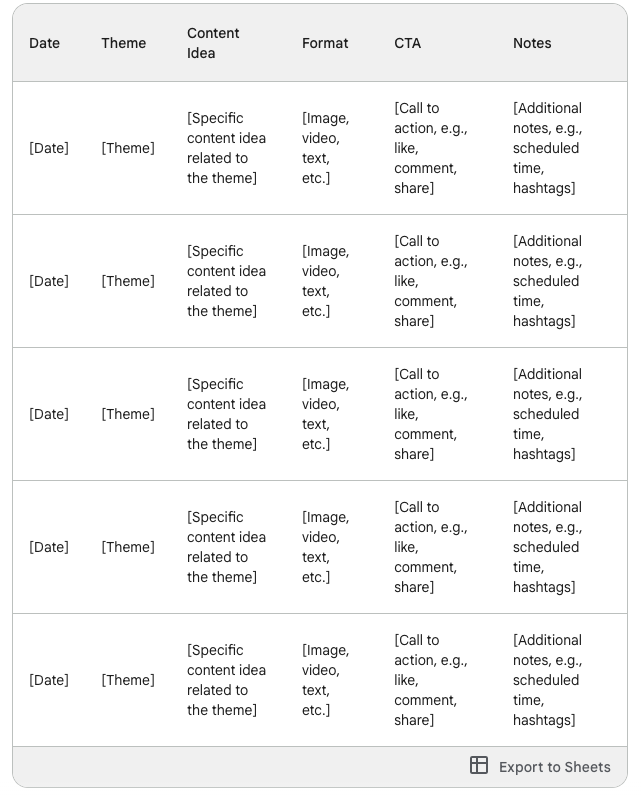
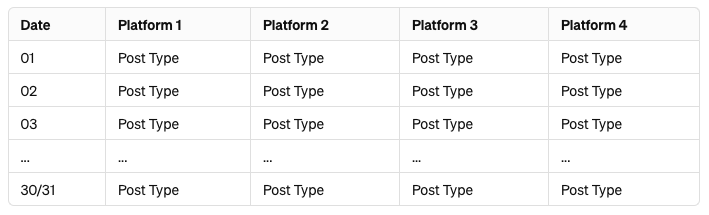
We asked both platforms to create a template for a social media content calendar. This type of template could be extremely valuable for businesses in the process of developing a social media marketing strategy.
Gemini produced a template that addresses several components of the social media content curation process, including content type, topic, and call-to-action. While Gemini offered some suggestions about what to consider before getting started, as well as some tips for a successful social media marketing strategy, the platform also seemed to recognize its own limitations, and recommended a few well-known sites that could provide further assistance, such as Hootsuite and Sprout Social.
ChatGPT’s template, on the other hand, was quite limited. It simply listed the date, platform, and type of post, such as “blog” or “quote.” As a stand-alone template, there is a great deal of information and guidance missing. While ChatGPT did offer guidance about what to include in the social media calendar template, the template itself would need some attention before it could be truly useful.
Take a look for yourself.
Gemini’s output: